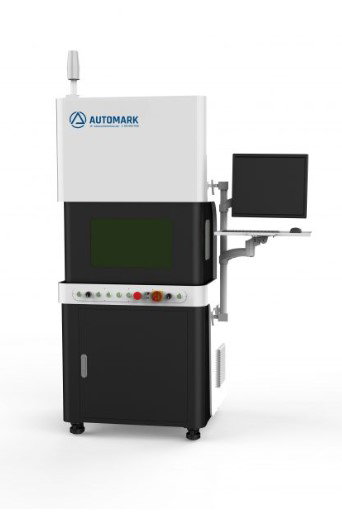
Product Overview
FIBER LASER
A fiber laser has an output of 1064 nm and is offered in two variants, the Q-switch and MOPA. Fiber lasers operate by either pulsing or continuously broadcasting the light onto the part. For fiber marking lasers, they are all pulsed lasers. Continous wave fiber lasers are usually 200 watt or higher and are for cutting metal.
The Q-Switch operates by pulsing energy (amplified light) onto a part. The pulse cannot be modified in terms of duration and is fixed. These are considered standard fiber lasers in the marketplace. Industry standards are 1-200 kHz, while the Automark AMFQ series line operates at 1-400 kHz. Our Q-Switch lasers provide a higher frequency than others in the marketplace allowing a greater range of printing capabilities which means it can print darker on aluminum and it can also print on an expanded range of plastics. It bridges the gap between a traditional Q-switch and MOPA fiber laser.
The MOPA (Master Oscillator Power Amplifier) allows for the pulse of the laser to be adjustable. This allows for finer detail as the substrate around the affected area is not transformed by continuous waves of heat. In addition to the pulse duration, the frequency itself is expanded to allow greater control. The frequency is 1-1,000 kHz, which means a larger amount of substrates, like polypropylene and marking white on PA plastics can be marked. The high degree of contrast also continues with the ability to mark black on aluminum and multiple colors on stainless steel.
MOPA fiber laser systems are also the choice for many medical applications as they are seen as more permanent surviving repeated cycling during sterilization.
No reviews yet. Be the first to share your experience.
Help others choose confidently by sharing your feedback.